

Why interpretation is the scarce resource
Most sustainability conversations focus on what already happened.
A new regulation passed. A technology launched. A company raised funding.
But the real challenge for leaders, investors and innovators is different.
How do we see what’s coming next?
Because by the time something becomes obvious…the opportunity is often already gone.
The problem with most “platforms”
In the sustainability space today, many initiatives describe themselves as: platforms, ecosystems, marketplaces, networks…
These labels promise scale and connection, but they often avoid a simpler question:
What is the real function here?
Connecting people can be useful. But connection alone doesn’t create clarity and in sustainability markets today, clarity is often the scarcest resource.
SustainMotion360 was built for something different
SustainMotion360 was never designed to be a marketplace. It was built as something else.
A reading layer.
A reading layer sits between information and decision.
Its role is simple: to interpret signals before they become obvious.
That means paying attention to things like:
Regulatory pressure
Industrial cost shifts
Procurement behavior
Capital allocation
Narrative changes shaping policy
Most signals look small when they first appear. But when several start moving in the same direction…something bigger is forming.
What a reading layer actually does
A platform connects people. A reading layer helps them see.
It focuses on:
Interpretation before visibility
Context before conclusions
Timing before hype
Judgment before scale
Because in emerging markets, mistakes rarely happen from lack of ideas.
They happen when we misread the moment. Acting too early or noticing too late.

A signal worth watching
Across sustainability markets right now, something interesting is happening. Three pressures are quietly starting to align.
First: regulation
Governments are increasing requirements around traceability and environmental reporting.
Second: procurement pressure.
Large buyers are beginning to demand verifiable sustainability data from their suppliers.
Third: technology costs.
Monitoring, reporting and verification systems are becoming cheaper and easier to deploy.
Individually, each of these signals looks incremental. But when they begin to converge…they can trigger structural change.
What used to be compliance gradually becomes competitive infrastructure. And the companies that understand this shift early usually move first.
Why this matters now
When signals like these begin to converge:
Sustainability data becomes strategic infrastructure
Suppliers increasingly need verification systems
Early adopters gain structural advance
This is how market shifts often begin… Quietly. Before they become obvious.
If you want to explore this deeper
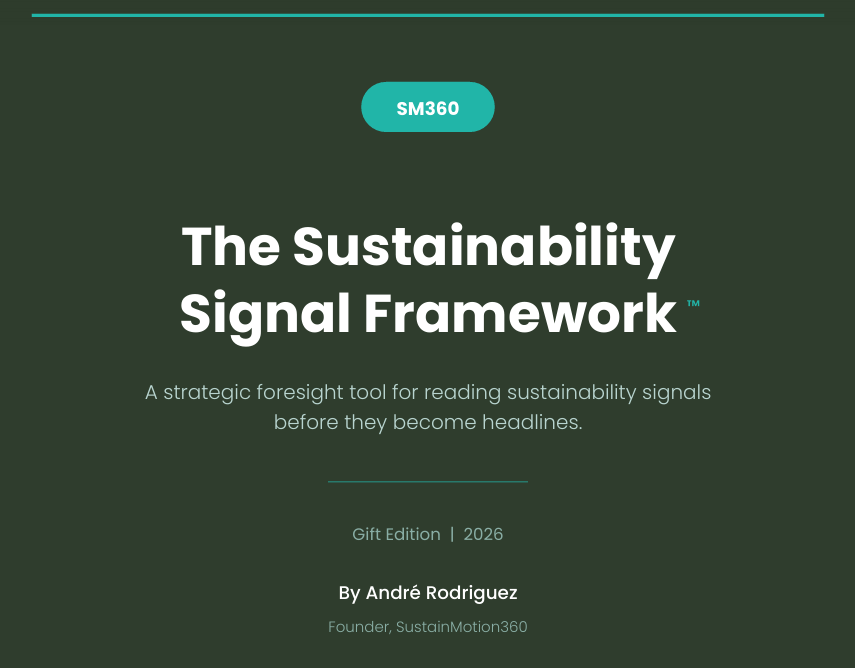
I recently put these ideas into a short guide:
The Sustainability Signal Framework.
It explains how sustainability signals begin to form before they become headlines.
You can download it here:
Sustainability markets rarely move in straight lines. They move when pressure builds quietly across multiple systems.
Regulation. Capital. Technology. Industry behavior.
The signals are always there. The challenge is learning how to read them.
Thank you for being part of this community.
With context,
André Rodríguez
Founder | SustainMotion360